
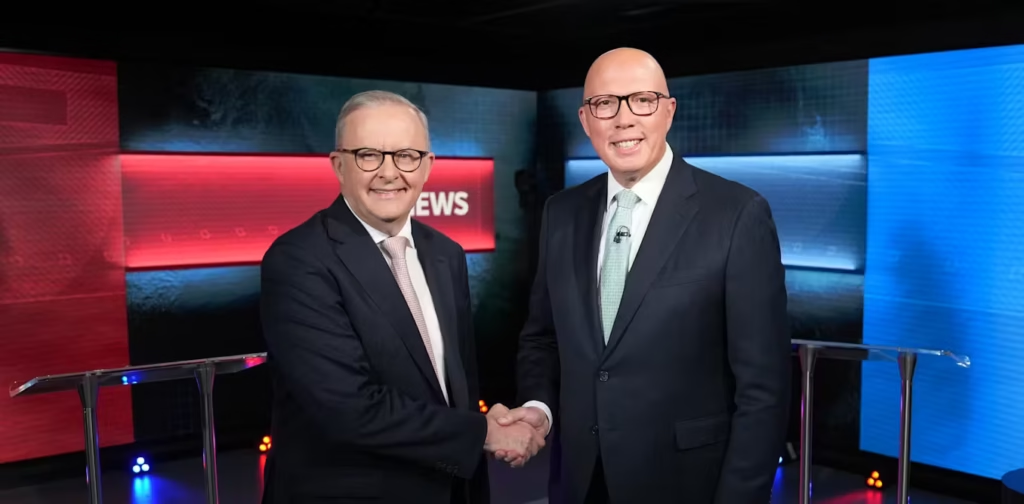
Throughout the 2025 federal election campaign, the leaders’ debates and media coverage — from The Australian to ABC News — highlighted a fundamental truth: leadership is judged not just by policy, but by communication.
In my recent radio interviews, I framed it this way:
“The first rule in the campaign, the prime directive if you like, is to win the votes. You’ve got to win the election before you can implement any of these strategies. And so much of it comes down to who is more persuasive, which candidate is more believable. Yes, it’s about their policy, but right now we\’re not seeing huge differences. Policy initiatives, especially when it comes to the cost of living. What are the differences, the sweeteners either party is offering? Who do we believe will actually live up to the messages or live up to the vision they’re putting forward? And one of the problems we have is that neither leader is putting forward a clear and cohesive vision.”
This absence of visionary leadership language was a defining feature of this campaign.
Anthony Albanese leaned heavily on steady, measured communication. His narrative focused on competence — the language of economic management, performance metrics, and policy execution. He resisted provocation, often diffusing heated moments and reinforcing stability. The Prime Minister is playing it safe in his campaign to protect his lead. This is reflected in his debate performance.
Peter Dutton, on the other hand, chose a more strident and at times combative style. He used the metaphor of a”lawless zoo” when describing the social media landscape for Australia’s children. As the‘strong’ candidate, he seeks to evoke the emotion of fear among voters and then present himself as the protector. But the policy points he continually comes back to, especially around the cost of living, do nothing to speak to this positioning.
Yet, as I discussed on air, the critical gap for both leaders was the failure to paint a compelling, unifying future.
In two of the four televised debates, the moderator directly asked the candidates to provide Australian voters with some inspiration. Neither rose to the challenge.
Great leadership communication moves beyond what and into why. It paints a future voters can see themselves in. It makes them feel part of something larger than themselves. Neither Albanese nor Dutton consistently crossed that threshold.
Where Was the Vision?
Globally, the most effective leaders master emotional storytelling anchored by metaphor. Ronald Reagan gave America a“Morning.” Barack Obama offered“Hope.” Even Jacinda Ardern, during a crisis, built a rallying cry around “Kindness.” These are not just slogans; they are emotional maps for a nation’s future.
The result? Debates that were peppered with detailed policy and promises but lacking in emotional lift. Australians were asked to choose between two administrators, not two national architects.