
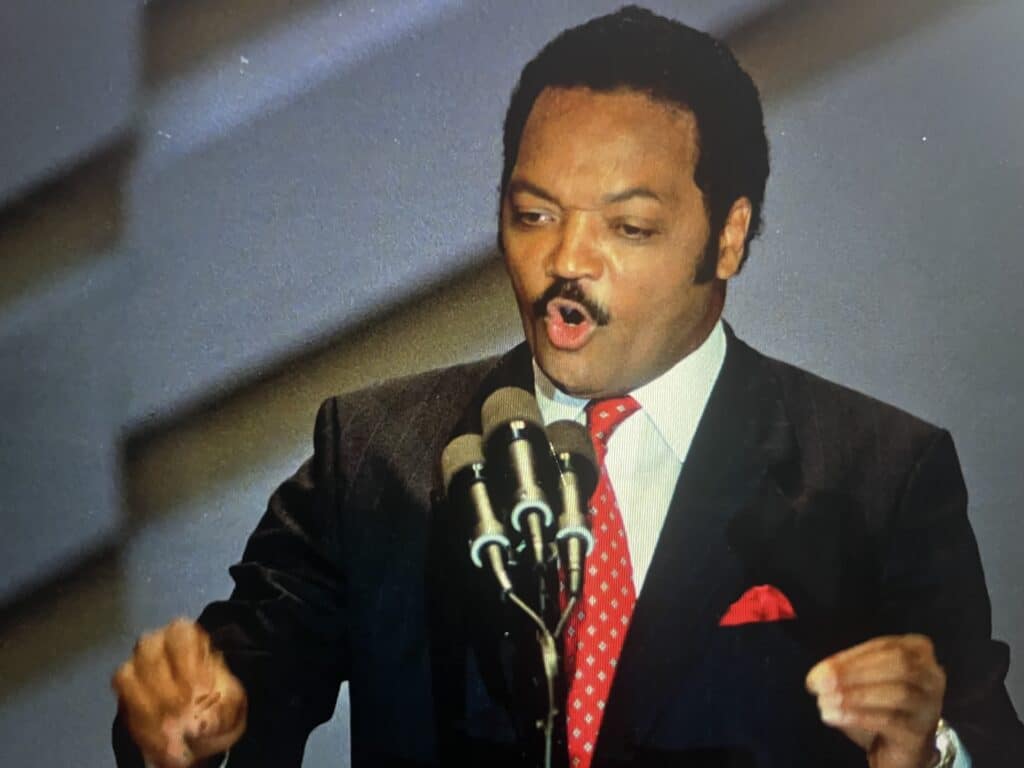
The recent passing of Jesse Jackson marks the end of an era in American public life. A towering figure in the civil rights movement, presidential politics, and faith leadership, Jackson’s legacy rests on the causes he championed and the way he gave them voice.
His craft was honed in the crucible of the movement alongside Martin Luther King Jr., where the pulpit met protest and rhetoric met risk. Like King, Jackson understood that words could move people.
Of course and entire book could be written on the speeches delivered by Jesse Jackson over the course of his lifetime, but here are my top three observations of what made him such a powerful and unforgettable orator.
1. The ability to connect lofty ideals to personal experience
High minded ideals like ‘unity’, ‘freedom’ and ‘progress’ abound in almost every aspirational political speech. Yet few speakers manage to evoke a personal connection, and therefore a deeply held understanding of these ideals in the hearts and minds of their audience.
In his 1988 address to the Democratic National Convention; the speech that popularized the refrain “Keep Hope Alive”, Jackson connected his political ideology with his personal history.
In one extended passage, Jackson declared:
“I understand.
I was born in Greenville, South Carolina.
I understand.
I grew up in the segregated South.
I understand.
I have seen the signs: ‘White’ and ‘Colored.’
I understand.
I know the pain of rejection.
I understand.
I know the humiliation of being told you can’t, when you know you can.”
Across the speech, variations of “I understand” are repeated more than a dozen times. The repetition makes it both lyrical and memorable.
He then pivots from empathy to collective responsibility:
“We must find common ground as a basis for survival anddevelopment andchange and growth.”
Notice the stacking of conjunctions – survival and development and change and growth. The repetition of “and” refuses incrementalism. Progress must be layered and continuous.
His ability to make the political deeply personal is a recurring theme in Jackson’s most memorable speeches. In his famous “I Am Somebody” address, first popularised in the 1970s through Operation PUSH gatherings, Jackson turned rhetoric into participatory affirmation:
“I am somebody.
I am somebody.
I may be poor, but I am somebody.
I may be on welfare, but I am somebody.
I may be small, but I am somebody.
My mind is a pearl. I can learn anything in the world if given a chance.”
Here, Jackson led a call-and-response, with the audience, often including children, repeating each line back to him. Now, this is a risky tactic, but Jackson had a special ability to read the room and operate in concert with his audience, and the effect is profound.
2. Master of Metaphor
Jesse Jackson’s speeches were liberally peppered with biblical allusions and imagery. You can here the echo of his mentor, Martin Luther King Jr, as well as the influence of his own background as an ordained Baptist minister.
In his 1984 address to the Democratic National Convention in San Francisco, Jesse Jackson drew directly from Ecclesiastes to frame the civil rights struggle as part of a larger moral season. Expanding beyond the short biblical reference, he said:
“There is a time to sow and a time to reap.
A time to plant and a time to harvest.
A time to labor and a time to enjoy the fruits of our labor.
We have sown the seeds of struggle in tears and sacrifice — now is the time to reap the harvest of justice.”
Four years later, in 1988, he offered a metaphor of a quilt in his argument in favour of pluralism:
“Progress will not come through boundless liberalism nor static conservatism, but at the critical mass of mutual survival…
Pull the patches and the pieces together, bound by a common thread.
When we form a great quilt of unity and common ground, we can cover the nation with hope.”
Later in the same speech he said:
“Our flag is red, white, and blue, but our nation is a rainbow — red, yellow, brown, black and white — and we are all precious in God’s sight.”
3. Rhetorical Swagger
A closer examination of Jackson’s many speeches reveal his signature style which perfectly complements the undeniable substance.
Here are just a few of my favourite examples…
Chiasmus
Reversing the order of words in two parallel consecutive phrases.
“I was born in the slum, but the slum wasn’t born in me.”
“Our party must be the party of hope, not the party of fear.”
Anaphora:
Repetition at the beginning of successive clauses.
“I understand
I understand the pain of joblessness
I understand the hurt of humiliation
I understand the challenge of survival.”
And…
“I am somebody
I am somebody
I may be poor, but I am somebody
I may be on welfare, but I am somebody.”
I may be on welfare, but I am somebody…”
Alliteration & Rhythmic Enumeration
“My constituency is the desperate, the damned, the disenfranchised, the disrespected and the despised.”
And..
“Keep hope alive.
Keep hope alive.
Keep hope alive
On tomorrow night and beyond, keep hope alive!”
And…
“We must not measure greatness from the mansion down but from the manger up.”
Final Reflection
Jackson’s legacy will persist for anyone looking to inspire others with their words. He has given us a treasure trove of examples where soaring rhetoric meets the everyday struggles of his community and constituency. His words will continue to inspire hope for people to unite in a shared commitment to progress.
Keep hope alive.