
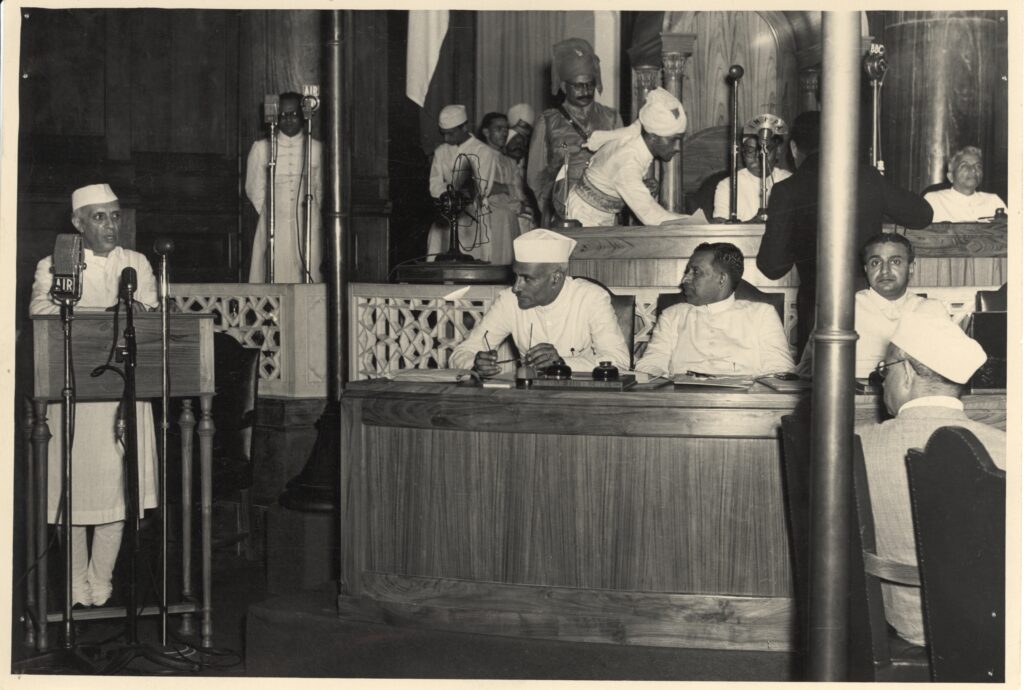
Speech Analysis
On 14 August 1947 Jawaharlal Nehru delivered a beautiful speech in Delhi India. ‘A Tryst With Destiny’ is one for the history books.
This was a speech that was perfectly of its time. And yet, there are lessons here for any modern leader who is seeking to guide people through a transformation, to unite a population or light the path for a new way forward.
“At the stroke of the midnight hour, when the world sleeps, India will awake to life and freedom.”
As the clock struct midnight, Jawaharlal Nehru addressed the Constituent Assembly in New Delhi. He marked a moment in time. Through his words he brought significance to the birth of a nation and the beginning of a profound social, political, and moral transformation.
It is a short but powerful address, just under five minutes.
Despite it’s brevity, this speech had a lofty purpose. Nehru sought to mark the historical significance of the event whilst defining the future direction of the nation.
Even now, all these years later, hearing Nehru’s words and the conviction in his delivery you understand this to be a pledge. A commitment to mark the break with the past (including all the turmoil and pain that went with it) and look toward the future.
I often write and speak about how critical the words of our leaders are. “They operate at the break-point moments in history”. And this is a fine example. In just five minutes Nehru seized the moment.
Here are three lessons we can all take away.
Use Contrast to highlight what is changing
The choice to juxtapose different ideas make perfect sense in this speech.
If you happen to be speaking on the subject of transition or even transformation painting the ‘from’ and ‘to picture’ is helpful. Imagine if Nehru had chosen to only speak about his ambitions for the bright and bold future of India without recognising the struggles that had gone before? The audience would be at best dissatisfied and at worst offended by the omission.
But, by contrasting what had gone before, with the hope for the future, Nehru strikes the right note.
“A moment comes, which comes but rarely in history, when we step out from the old to the new, when an age ends, and when the soul of a nation, long supressed, finds utterance.”
and…
“Before the birth of freedom we have endured all the pains of labour and our hearts are heavy with the memory of this sorrow. Some of those pains continue even now. Nevertheless, the past is over and it is the future that beckons to us now.”
Appeal to High Ideals
In addition to a high or formal style, Nehru places at the centre of his appeal the need for his audience to rise above previous grievances and struggles. He takes the position that the only way to move forward is elevate above the chaos, opposition and pain. He repeatedly encourages his audience to adopt the ideals of the New India and the values of a shared vision.
“Freedom and power bring responsibility. The responsibility rests upon this Assembly, a sovereign body representing the sovereign people of India. Before the birth of freedom we have endured all the pains of labour and our hearts are heavy with the memory of this sorrow. Some of those pains continue even now. Nevertheless, the past is over and it is the future that beckons to us now.”
and…
“To the people of India, whose representatives we are, we make an appeal to join us with faith and confidence in this great adventure. This is no time for petty and destructive criticism, no time for ill-will or blaming others.”
Lofty but not Lengthy
The tone of this speech is formal, high-minded and yes, lofty. This is an appropriate choice but if Nehru were to speak for longer the audience may become disengaged unless presented with a variation in tone.
Speeches that are too lofty AND go on for too long tend to lose the audience along the way. It can start to feel like a lecture or even a sermon. Fidel Castro was certainly prone to such a grandiloquent style.
“A Tryst with Destiny”, however, is a beautiful piece of oratory. Partly because of its brevity.
The language is elegant. A succinct encapsulation of his message of hope and transformation.
“Long years ago we made a tryst with destiny, and now the time comes when we shall redeem our pledge, not wholly or in full measure, but very substantially. At the stroke of the midnight hour, when the world sleeps, India will awake to life and freedom.”
One for the History Books
This is a speech that will continue to resonate for years to come. But there are lessons that can be extracted and used today.
For anyone that needs to unite a divided team, activate commitment or share a vision for a better tomorrow, Nehru will provide inspiration and practical lessons.