
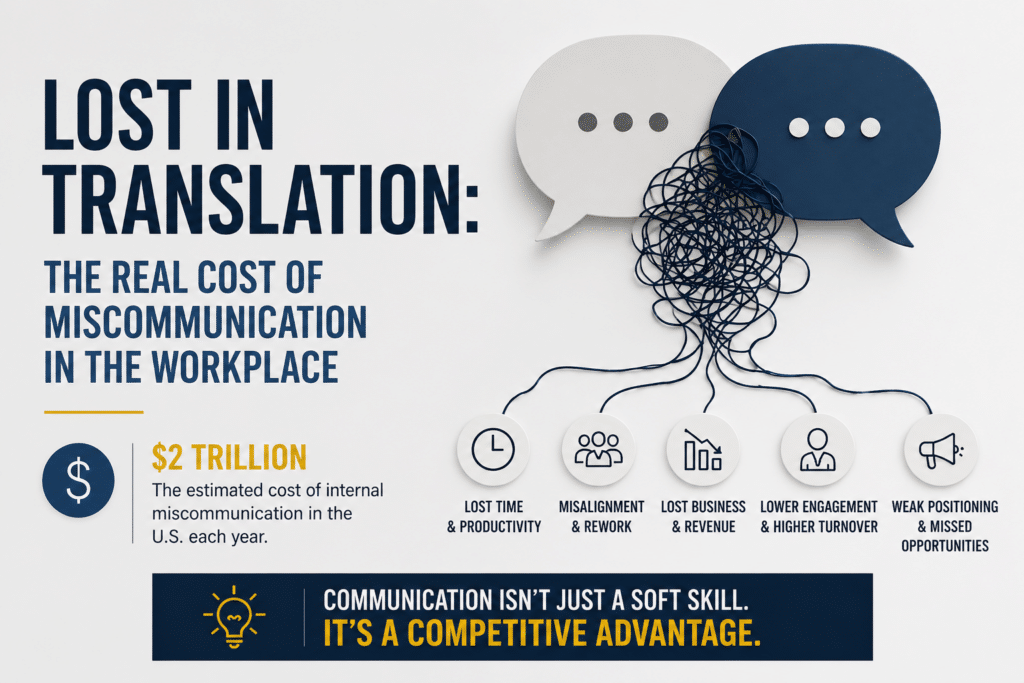
Communication skills are often thrown in the ‘nice to have basket’. But what if you could quantify the real cost of miscommunication in the workplace?
According to AxiosHQ the cost of internal miscommunication in the United States could be as high as $2 trillion. That is just internal comms, and only in the USA.
But we know there are lots of other leaks where the money flows the wrong way because our people cannot communicate persuasively.
We’ve all had the frustrating experience of being misunderstood. But the true implications of poor communication are far more dire than personal frustration.
The Direct Cost: Time, Salary and Productivity Leakage
According to the same AxiosHQ report, employees spend about 57% of their time engaged in communication based activities. (These are largely corporate, professional and technical services respondents).
We could extrapolate this statistic to question the effectiveness of more than half the time that all of your employees are working. When they are communicating, are they doing so effectively or ineffectively.
The numbers are worse when we look at senior leaders as a subset of all employees. Among this cohort the estimated time wasted by communication inefficiencies is 63 days per year.
Take the salaries of your most senior people and work out the dollar cost of those ‘lost’ 63 days.
Whether we add it up or not, the fact is that you are already paying the price for poor communication in the workplace.
The Hidden Cost: Misalignment, Rework and Failed Execution
Miscommunication compounds into execution failure.
For every directive that is delivered in a confusing manner there are teams of people unsure of what decisions to make and what work is a priority. This means direction is reset midstream, causing costly realignment.
For every misunderstood priority work is completed that is not required, or at least not required in the moment. Sometime days, weeks or months of effort are written off.
Another hidden cost is buried in the attitudes of dissatisfied employees. According to this research only 8% of employees feel fully aligned with company goals. What’s more interesting is that this gap often goes unrecognised with 80% of leaders thinking that communication has been clear.
More diagnosis, awareness-raising, and recognition that communication is always a two-way process are clearly needed.
Some of the impacts of this communication gap include:
- Duplicate work
- Slower decision-making
- Poor prioritisation
- Constant firefighting
When the problem compounds over time, cultural problems begin to emerge. Consider a scenario where poor communication from senior leaders results in a belief that there is no clear strategy. This is then perceived as a leadership vacuum creating perfect conditions for backstabbing and self-promotion.
The Opportunity Cost: Failed Pitches and Poor Positioning
Perhaps the most obvious cost of poor communication appears in the external environment. In the business development space the losses are painful to examine but they might include; poor conversion rates from competitive pitches, clients that go quiet and proposals that fail to advance.
Successful past projects need to find a new life in the form of a case study story if they are to have value in the future. What is the cost to your business of attracting new customers and winning new work?
In professional and technical services in particular, thought leadership is important for positioning your business in the marketplace. This means building influence through industry presentations, panel discussions and media.
These costs show up strikingly in any set of business metrics and they are not captured in the Axios HQ $2 trillion estimate as that particular study looks at internal communication. There is, however, great synergy between the skills needed to influence internal and external stakeholders.
A Silver Lining?
The flip side of this rather depressing coin is that we can safely say that communication is not a nice to have, it is a competitive lever. If that is true there is a clear opportunity to achieve some tangible benefits by investing in improved communication for our leaders, our experts and our business developers.
Perhaps having the best strategy is not enough.
The winners are those that communicate the winning strategy with clarity and conviction.