
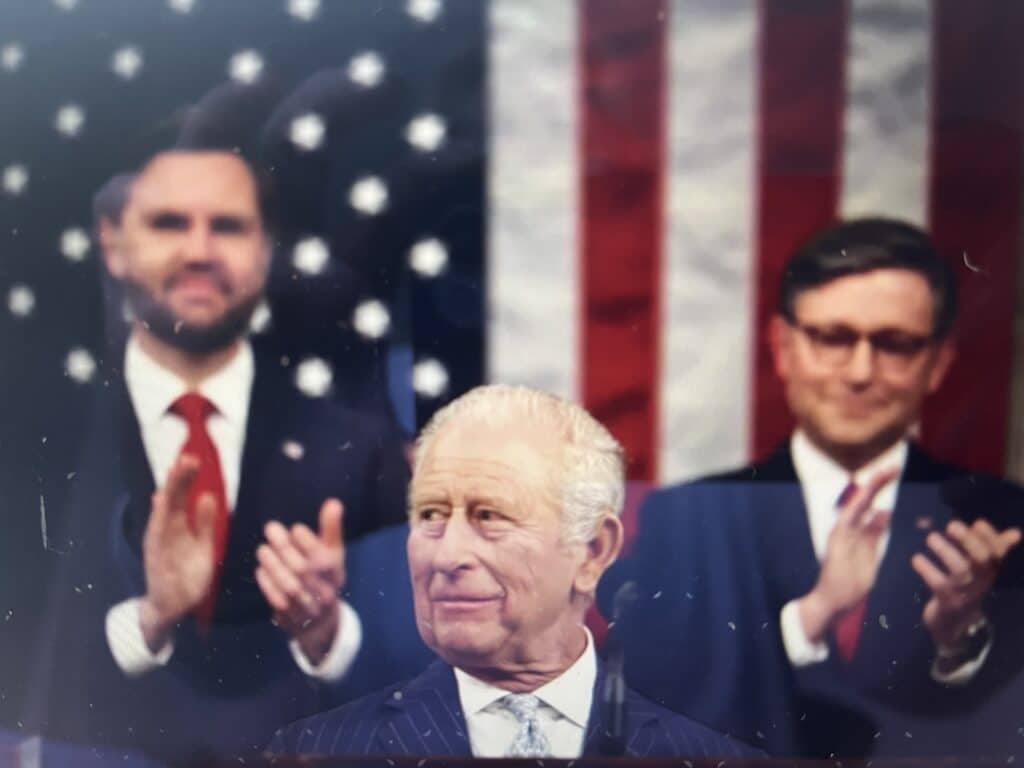
King Charles III delivered his address to Congress in Washington DC on 29 April 2026. On the surface it was a speech of warmth, continuity and shared history. Beneath that surface, however, it carried a series of careful messages on subjects including climate change, the war in Ukraine, NATO cohesion and even the treatment of foreign nationals. Each was delivered not as confrontation, but as suggestion. Not as criticism, but as calibration. And always in a style that is unmistakably British: restrained, diplomatic, and deliberately indirect.
At moments, the speech gently pressed on areas of tension between allies. On climate, it leaned towards stewardship and urgency without accusation. On Ukraine, it reinforced resolve without naming division. On NATO, it emphasised unity without highlighting strain. And on broader questions of international responsibility, it framed values rather than judgements. The effect was not to avoid difficult topics, but to pass through them with such care that they became almost imperceptible as points of friction.
Charles quoted Oscar Wilde, saying: “We have really everything in common with America nowadays, except, of course, language.” He might equally have invoked George Bernard Shaw’s observation that the two nations are “divided by a common language”.
Both remarks point to something deeper than differences in accent or vocabulary. They hint at a divergence in how language itself is used. In British rhetorical tradition, it is often considered more effective to imply than to state directly. In American political culture, clarity and explicitness are more highly valued.
These differences reflect underlying cultural norms. As Noam Chomsky observed: “Language is not just words. It is a system for generating and interpreting meaning.” What is said is only part of what is communicated. How it is said, and how it is heard, matters just as much.
When King Charles spoke in Washington, he managed to land several significant points that might, in a different register, have been heard as direct criticism. Instead, they passed through the room in a different form. The language was sufficiently gentle that it did not trigger resistance, yet sufficiently clear that the meaning remained intact.
In fact, at several moments the chamber rose to its feet in applause. Members of Congress from both sides responded not to confrontation, but to phrasing that allowed agreement without demand. It was diplomacy in its most refined form: persuasion without pressure.
Decorum
The concept of decorum comes from classical rhetoric, particularly the work of Cicero and Aristotle. It describes the principle that effective speech must suit its speaker, audience and occasion. Meaning is not only in what is said, but in what is appropriate to say, and how it is said.
“It is with a profound sense of humility and respect that I stand before you today.”
“I come before you as a friend of the United States.”
These opening lines establish the framework of the entire speech. They define the speaker’s position before any argument is made. Charles does not present himself as a political actor but as a constitutional figure operating within careful limits of tone and authority.
Throughout the address, praise for American values and achievements is woven into the structure of the speech. At times it is explicit, at others more implied, but it consistently reinforces goodwill. The result was repeated applause, and at several points standing ovations.
He concluded simply:
“God bless the United States and God bless the United Kingdom.”
The response was immediate and emphatic. The audience was clearly aligned with the tone and intent of the speech.
The Art of Understatement
British communication often relies on saying less in order to mean more. Nancy Mitford once observed that “there is a whole language of class in England which depends not on what is said but how it is said.” That principle extends beyond class into diplomacy itself.
A litote is a rhetorical form of understatement that expresses an idea by negating its opposite. It reduces intensity while preserving meaning.
“We do not always agree, at least in the first instance.”
“The challenges we face are not insignificant.”
Both phrases soften their content while leaving the underlying message intact. Disagreement is acknowledged but contained. Difficulty is recognised but moderated.
At one point, Charles even translated American historical framing into British idiom, noting:
“Or as we say in the United Kingdom, just the other day.”
The effect is subtle humour, but also a reminder of distance and proximity existing at the same time.
Establishing Common Ground
One of the most consistent techniques in the speech is the establishment of shared reference points before addressing more complex themes. This is a well-known principle in negotiation and rhetoric: agreement first, detail later.
Charles repeatedly emphasised shared history and shared values between Britain and the United States.
“Ours is a partnership born out of dispute, but no less strong for it.”
“We have always found ways to come together.”
These lines do not argue a position. They create a space in which agreement already feels established. Within that space, more delicate messages can be delivered without disruption.
Conclusion
King Charles’ speech to Congress was not simply an exercise in diplomacy. It was an example of rhetorical design shaped by centuries of British communicative tradition.
Across its structure, three things stand out. First, decorum governs the limits of what can be said and how it can be said. Second, understatement allows potentially difficult ideas to be absorbed without resistance. Third, appeals to common ground ensure that meaning is carried within a shared framework rather than imposed upon it.
What makes the speech distinctive is not what it declares, but how carefully it avoids declaring anything too directly. It operates in the space between statement and suggestion, where meaning is implied rather than imposed.
For an American audience accustomed to explicit political expression, much of this may feel understated. For a British ear, it is simply how serious things are often said.
In that sense, the speech is less about what was said than how meaning travels across different expectations of language itself.